


Baccarat Rules With 7 Crucial Mistakes to Avoid
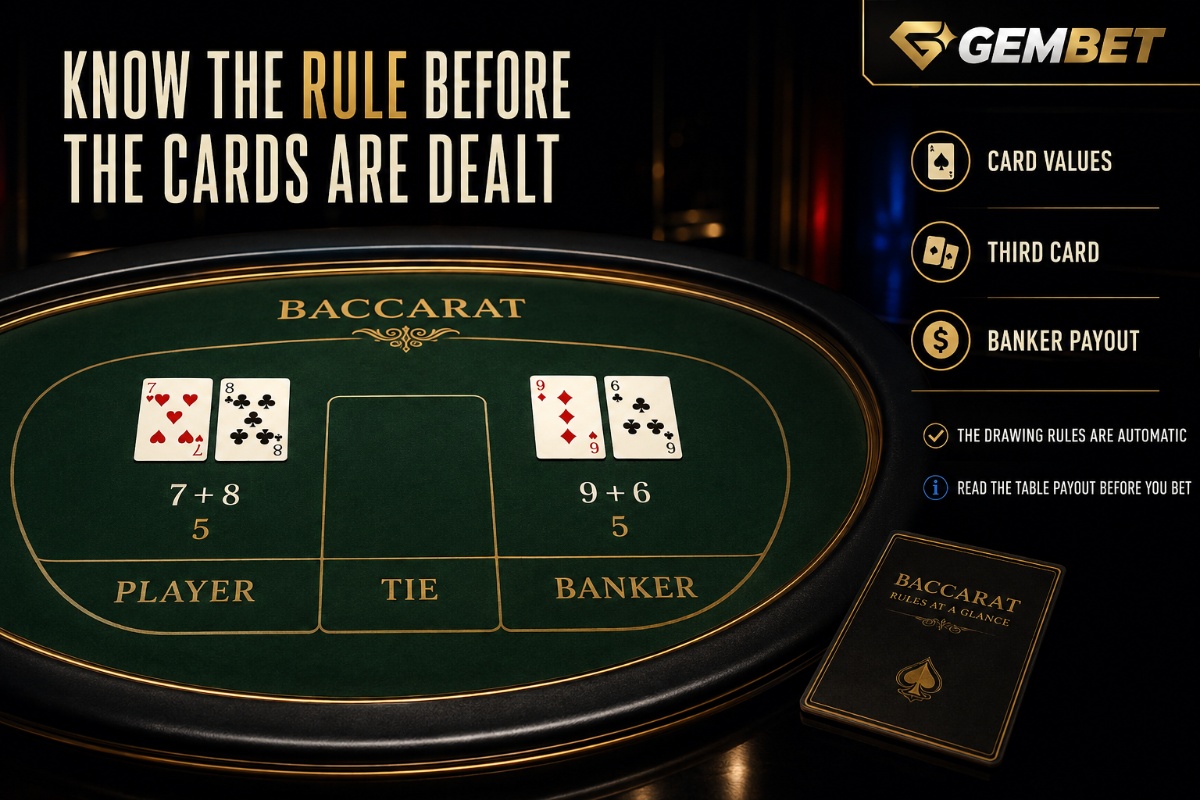
Baccarat rules are simple at the centre of the game: players choose Player, Banker or Tie, then the cards are dealt according to fixed drawing procedures. The challenge is not deciding whether to hit or stand. It is understanding hand values, third-card conditions, commission, table variations and how each wager is settled before money is placed.
This guide focuses on the parts that cause the most confusion. Baccarat rules can look similar across tables while payout details differ, so the information panel matters.
What are baccarat rules?
Baccarat rules determine how card totals are calculated, when either hand receives a third card and how Player, Banker and Tie wagers settle. Aces count as one, cards from two through nine keep their face value, and tens plus picture cards count as zero. Only the final digit of a total matters.
For example, a seven and an eight total fifteen, so the hand value is five. A nine and a six also total fifteen and therefore have the same baccarat value.
1 Learn the hand values before watching the road map
The first baccarat rules to learn are the card values. If two cards total ten or more, drop the first digit. A six and a seven make thirteen, which becomes three. A nine and an eight make seventeen, which becomes seven.
This single-digit system explains why apparently strong-looking card combinations can still produce a low total. It is more useful to understand this calculation than to study previous results before the first wager.
2 Know what Player Banker and Tie actually mean
Under standard baccarat rules, Player and Banker are simply the names of the two hands. They do not mean the person at the screen versus the casino dealer. A Player wager wins when that hand finishes with the higher total, while a Banker wager wins when the other hand is higher.
A Tie is a separate outcome when both hands finish with the same value. Its payout and effect on the two main wagers should be checked in the table information because variations can differ.
3 Do not make your own drawing decision
Unlike blackjack, baccarat rules use predetermined procedures to decide whether another card is drawn. The bettor does not choose Hit or Stand. Once wagering closes, the dealing sequence follows the table logic automatically.
A natural total of eight or nine normally ends the drawing process. Otherwise, the fixed procedure determines whether another card is dealt.
4 Understand why the third-card rule looks complicated
The third-card section of baccarat rules can look complicated because the Banker procedure uses conditional values. Players do not need to memorise the matrix, but they should understand that the dealer follows a defined procedure rather than making a discretionary choice.
5 Check the Banker payout before choosing a table
Traditional baccarat rules commonly attach commission to winning Banker wagers because of the mathematical structure of that side. Some tables instead use a no-commission variation with a modified payout or special treatment for a particular Banker result.
Do not assume that “no commission” means every winning Banker outcome pays the same as a standard table. Open the payout information and check the exact settlement condition first.
6 Treat side wagers as separate games within the table
Pair, perfect-pair or other optional bets can sit beside the core choices. These are not extensions of the main baccarat rules in the sense of changing which hand wins. They are separate conditions with their own qualification and payout structure.
A large displayed return generally corresponds to a narrower event. Read each optional wager independently rather than assuming it has the same risk profile as Player or Banker.
7 Ignore streaks when applying baccarat rules
Many live tables display previous outcomes in roads or history panels. These records can show what happened, but baccarat rules do not contain a mechanism that forces the next hand to reverse or continue a pattern.
A sequence of Banker results does not make Player due. An alternating pattern also does not guarantee another switch. Use the history display as a record, not as a prediction engine.
How do the three main outcomes compare?
| Wager | What must happen | Main detail to check |
|---|---|---|
| Player | Player hand finishes higher | Standard payout shown by the table |
| Banker | Banker hand finishes higher | Commission or modified settlement |
| Tie | Both hands finish with the same total | Separate payout and main-bet treatment |
This comparison is useful because baccarat rules are fundamentally about settlement. The visual style of the studio does not change what the selected outcome needs to achieve.
What happens when the first two cards total eight or nine?
In standard baccarat rules, an initial total of eight or nine is called a natural. The hand normally stands and no additional card is drawn, subject to the table’s stated procedures.
How is a total above nine calculated?
Only the last digit counts. Under baccarat rules, twelve becomes two, fourteen becomes four and eighteen becomes eight. There is no bust for going over a target in the way blackjack uses twenty-one.
Do suits matter in the main game?
For the core comparison, baccarat rules are based on card values rather than suits. Hearts, diamonds, clubs and spades do not make one main hand stronger than another when the numerical totals are equal.
Why do Banker and Player not have identical mathematics?
The fixed drawing procedures create a small structural difference between the two sides. This is why traditional tables often apply a commission to the Banker outcome. The important practical point is to read the actual payout rather than assuming both main wagers are priced identically.
How does a no-commission table change the comparison?
A no-commission label removes the traditional fee mechanism, but it may replace it with another rule. Some formats reduce the payout for a specified Banker total or apply another modification.
Because baccarat rules vary by version, the phrase “no commission” should trigger a rules check rather than an assumption that the underlying mathematics became more favourable.
Table speed changes how quickly wagers repeat
A speed version can shorten the time between completed hands. Faster dealing does not change baccarat rules, but it can increase how many wagers fit into the same session.
30 hands × S$2 = S$60 turnover
50 hands × S$2 = S$100 turnover
Turnover is the amount put into action, not a prediction of loss. The example simply shows why pace deserves attention alongside limits and payout wording.
Use the game information instead of memorising every exception
Players sometimes feel they need to memorise the complete third-card matrix before joining. That is unnecessary for normal participation because the dealing procedure is automatic. What matters more is understanding the core baccarat rules and checking the table-specific details that can affect settlement.
How does baccarat differ from other casino formats?
Baccarat asks for a main outcome before the cards are dealt and then follows fixed procedures. Blackjack can require decisions during the hand, while roulette uses a wheel and a larger pre-result betting layout.
If you are still comparing categories, the casino games guide explains how pace, interaction and settlement differ across common formats.
Seven mistakes worth avoiding before the first hand
- Assuming Player means the person playing the game.
- Treating previous outcomes as a forecast.
- Ignoring commission or modified payout wording.
- Believing the bettor decides whether a third card is drawn.
- Using an optional wager without reading its condition.
- Increasing the stake because a streak looks convincing.
- Choosing a fast table without considering session turnover.
These errors are avoidable because baccarat rules are available before the wager. Read the information panel rather than infer rules from animations.
Mobile players should check visibility before betting
On a smaller screen, the video feed, chip controls, history display and optional bets can compete for space. Baccarat rules do not change on mobile, but poor visibility can make it easier to tap the wrong outcome or overlook the current stake.
Before confirming, make sure Player, Banker, Tie, the amount and the remaining betting time are all clear.
Gembet users should read the exact table information
Gembet currently includes baccarat among the live-casino formats it presents. Individual rooms can vary in pace, limits and settlement details, so use the exact table information rather than assumptions from another version.
Baccarat rules are easier when settlement comes first
Baccarat rules become straightforward once the game is reduced to a few core ideas: calculate totals by the last digit, recognise Player and Banker as hand labels, let the fixed procedure handle third cards, and read the payout terms before choosing a wager.
Most complexity comes from table variations and optional markets rather than the core dealing process.
When browsing Gembet, use the lobby to identify an available table, then check its payout wording, pace and optional conditions. Clear baccarat rules make the table easier to understand without pretending that the next two hands can be predicted from the last ten.
Experience the real deal with SG's top Live Dealers. Play Baccarat, Roulette & more.

