


Learning Casino Hold’em One Decision at a Time
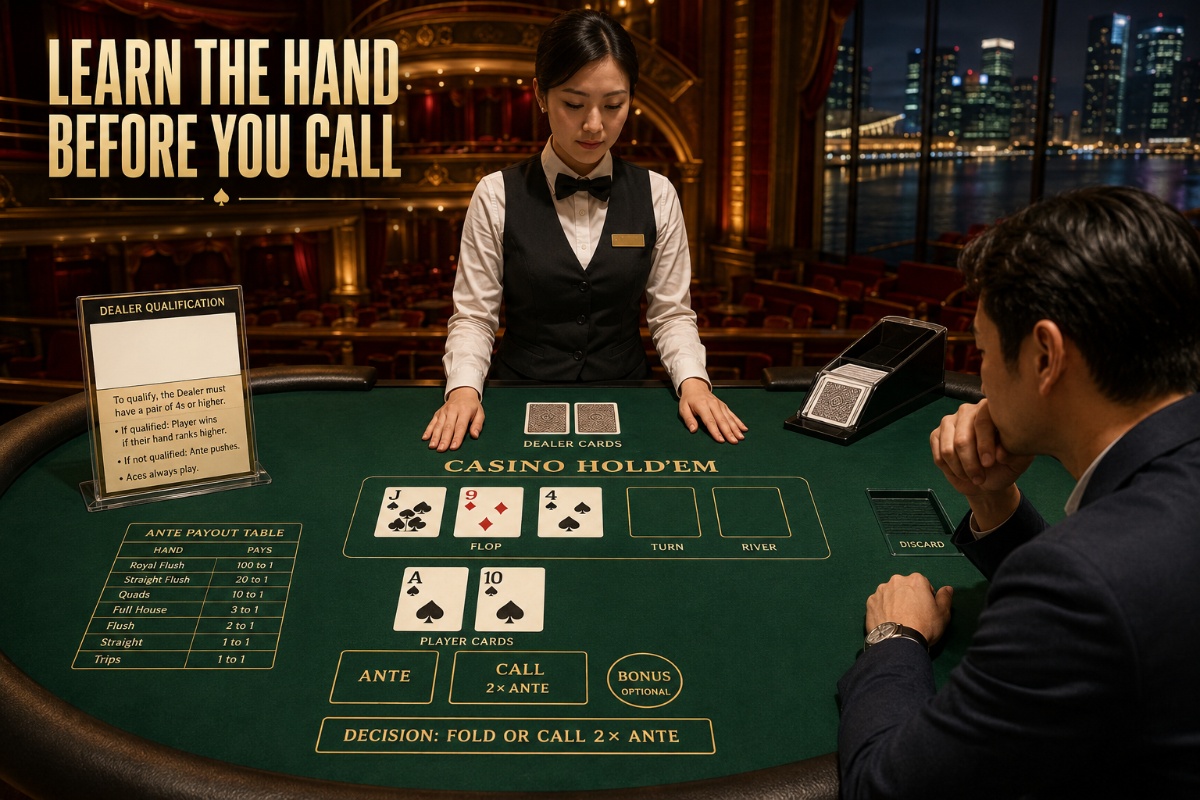
Casino Hold’em guide readers should begin with one distinction: this is a table game played against the dealer, not a poker room where players compete against one another. The player makes an Ante, receives two private cards, studies three community cards, and then chooses whether to fold or make the Call. The final result depends on the best five-card hand, dealer qualification, and the table’s payout schedule.
Understand the round before placing the Ante
A Casino Hold’em guide should first map the full round. The player places an Ante, then both player and dealer receive two private cards. The player’s cards are visible, while the dealer’s remain concealed. Three community cards are dealt face up to form the flop.
At that point, the player must either fold or continue. Folding ends the hand and loses the Ante. Continuing normally requires a Call equal to twice the Ante, although the exact table rule should always be checked before play. After the decision, two more community cards are dealt and both hands are compared.
Know what the Ante and Call actually do
In a Casino Hold’em guide, the Ante and Call should be treated as separate bets with different purposes. The Ante opens the hand. The Call keeps the hand active after the flop. If the player folds, no Call is placed, but the Ante is lost.
Suppose the Ante is S$10. A standard Call of twice the Ante would require another S$20 to continue. The total amount committed to that completed hand becomes S$30 before any optional side bet:
S$10 Ante + S$20 Call = S$30 total committed
This calculation matters because the visible table minimum may refer only to the Ante. The real amount needed to complete a hand can be higher.
Build the best five-card poker hand
Casino Hold’em guide decisions use ordinary poker-hand rankings. The player combines the two private cards with the five community cards and uses the strongest possible five-card hand. The dealer does the same.
- Royal flush
- Straight flush
- Four of a kind
- Full house
- Flush
- Straight
- Three of a kind
- Two pair
- One pair
- High card
Not every private card must be used. The strongest five cards may use both, one, or neither private card. Beginners often misread the result by trying to force both hole cards into the final hand.
Read the flop as a decision point
The most important Casino Hold’em guide skill is evaluating the player’s two cards together with the three-card flop. This is the only point where the player decides whether to fold or Call.
Start by identifying the made hand. Then look for realistic ways the turn and river could improve it. A pair, four-card flush possibility, open-ended straight draw, or strong high-card combination may create different reasons to continue. However, the exact decision should not be based on the hope that any random card will help.
The first Casino Hold’em strategy check is to list the cards that genuinely improve the five-card hand rather than counting every unseen card as useful.
Dealer qualification changes the payout
A Casino Hold’em guide must explain dealer qualification because beating the dealer and receiving an Ante payout are not always the same event. In a common version, the dealer qualifies with a pair of fours or better. Different regulated or provider versions can use another threshold, so the active rules remain essential.
If the dealer does not qualify, the Call commonly returns as a push while the Ante is paid according to the table’s Ante schedule. If the dealer qualifies and the player wins, the Call generally pays even money and the Ante uses its posted payout table. When the dealer qualifies and wins, both wagers normally lose.
| Dealer outcome | Player outcome | Common settlement pattern |
|---|---|---|
| Does not qualify | Player remains in hand | Call pushes; Ante pays by table |
| Qualifies | Player has better hand | Call pays 1:1; Ante pays by table |
| Qualifies | Dealer has better hand | Ante and Call lose |
| Qualifies | Hands tie | Ante and Call commonly push |
Check the Ante payout table separately
Casino Hold’em guide comparisons should include the Ante schedule.
Casino Hold’em guide readers should not assume that every winning hand receives the same Ante return. Many versions use a graduated payout table. A straight or lower may pay less than a flush, full house, four of a kind, straight flush, or royal flush.
The return can vary by table, so check every qualifying-hand payout in the active information panel.
This second Casino Hold’em strategy check is to compare the dealer qualification rule and Ante table together. Looking at one without the other gives an incomplete picture of the hand’s settlement.
Do not confuse Casino Hold’em with Texas Hold’em
A Casino Hold’em guide should separate this game from ordinary Texas Hold’em. Both use two private cards and five community cards, but the betting structure and opponent are different.
Review optional bonus bets independently
Casino Hold’em guide readers should separate bonus bets from the main hand.
Some tables include an optional AA or bonus wager based on the player’s first five available cards, usually the two private cards plus the flop. A Casino Hold’em guide should treat this as a separate side bet rather than part of the main Ante-and-Call decision.
Bonus payouts can look large because qualifying hands occur less often. Check the qualifying hand, payout table, stake limits, and settlement timing. A bonus win does not guarantee the main hand will beat the dealer.
Use community-card texture rather than one card alone
Casino Hold’em guide analysis improves when the flop is read as a group. Suited cards can create flush possibilities, connected ranks can create straight draws, and a paired board can strengthen both sides.
Understand ties and kicker comparisons
A Casino Hold’em guide should include kicker rules because shared pairs or board-made hands can be decided by the next highest unused card.
If both sides hold a pair of queens, compare the highest remaining cards in order. If the same five community cards form the best hand for both sides, the result is a tie.
Check table limits beyond the advertised minimum
Casino Hold’em guide budgeting must include the Call.
Casino Hold’em guide budgeting should account for the Call and any bonus bet. A S$5 Ante table can require S$15 to complete one main hand when the Call is twice the Ante. Adding a S$5 bonus would raise total exposure to S$20.
Before choosing a table, calculate:
Maximum planned round cost = Ante + Call + optional bonus
If the session budget is S$100 and one completed round can cost S$20, only five full round amounts fit inside the budget before any return. This is not a recommended number of hands. It shows how the betting structure affects session length.
Review the live or digital table controls
When Casino Hold’em appears in a live or digital format, check the decision timer, automatic controls, table limit, game history, and connection stability. A short timer can encourage an unreviewed Call, while an automatic repeat control can copy a stake that no longer fits the plan.
Verify the active rules on Gembet
Before opening Casino Hold’em on Gembet, review the current game panel for the provider, Ante minimum, Call multiple, dealer qualification, Ante payouts, bonus conditions, and maximum total payout. Availability and rules may vary, so the active table should remain the final source.
Readers comparing the best table and crash games should also recognise that Casino Hold’em requires a card-ranking decision after the flop, while crash games use a completely different timing and multiplier structure. The two categories should not be evaluated through the same method.
A practical decision routine for each hand
A Casino Hold’em guide can be reduced to a repeatable sequence:
- Check the table: Confirm the Ante, Call multiple, qualification rule, and payouts.
- Read the five visible cards: Combine the private cards with the flop.
- Identify the made hand: Use the strongest current five-card ranking.
- List real improvements: Count only turn and river outcomes that genuinely help.
- Review total exposure: Include the required Call and any bonus wager.
- Confirm the choice: Fold or Call before the decision window closes.
The final Casino Hold’em strategy check is whether the decision still makes sense after the potential Ante payout and bonus display are ignored.
Using a Casino Hold’em guide at the table
Casino Hold’em guide knowledge is most useful when it clarifies the structure of the hand. The Ante starts the round, the flop creates the only main decision, the Call usually doubles the Ante, and dealer qualification affects how winning wagers are paid.
Read the exact table rules, build the best five-card hand correctly, and include every required wager in the session budget. No hand is guaranteed to improve on the turn or river, and a large side-bet payout does not make that market more likely to win. A clear decision process is more reliable than chasing losses or continuing simply because the next card might complete a draw.
Experience the real deal with SG's top Live Dealers. Play Baccarat, Roulette & more.

