


Casino RTP Explained With 7 Powerful Facts for Easy Comparison
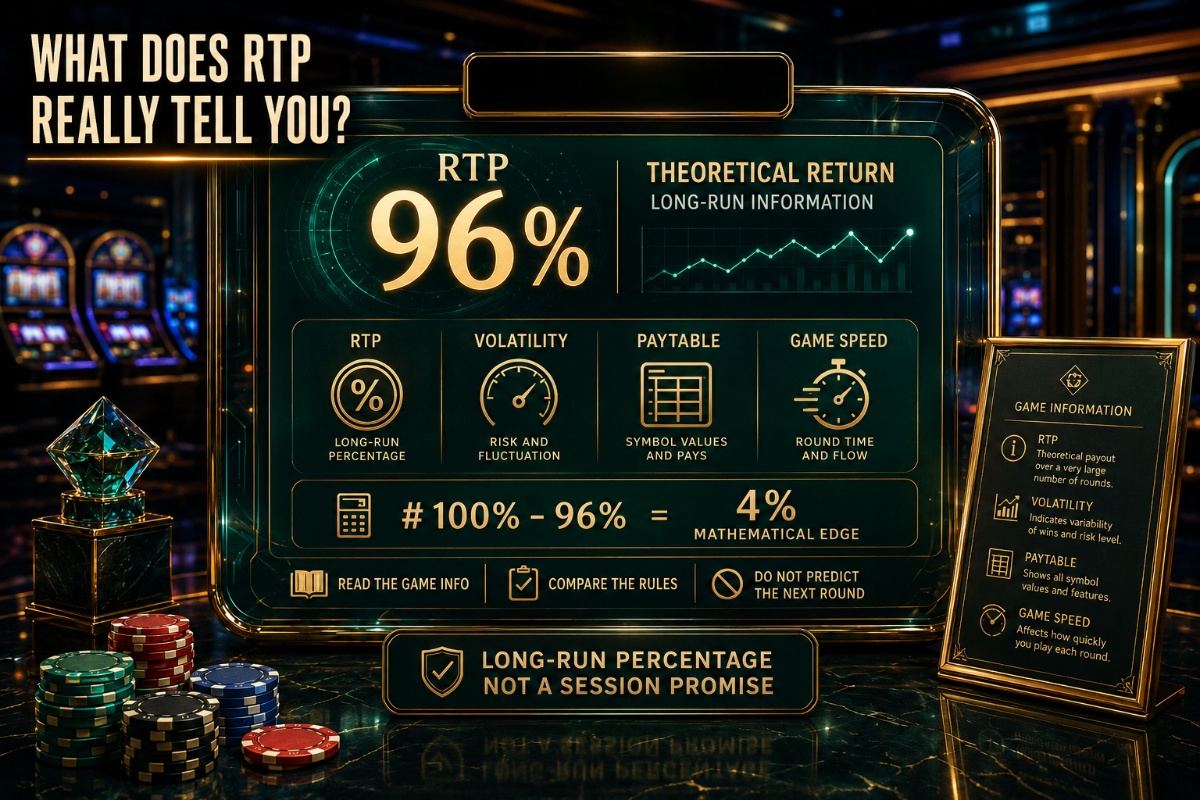
Casino RTP is a percentage used to describe the theoretical amount a casino game returns to players over a very large number of rounds. It is not a promise for one session, one hundred spins, or one evening of play. On Gembet, checking the published figure alongside the game rules can help players compare titles more clearly before choosing what to open.
The most useful way to read casino RTP is as long-run design information. A figure such as 96% does not mean a player will receive S$96 back from every S$100 wagered. Short sessions can finish far above or below the theoretical average because individual outcomes remain random.
What does casino RTP actually mean?
Casino RTP stands for Return to Player. If a game is listed at 96%, the theoretical model returns 96 units for every 100 units wagered across a very large sample of play, with the remaining portion representing the mathematical house edge before other conditions are considered.
That makes casino RTP useful for comparing game configurations, but it should not be treated as a forecast. The percentage is based on long-run mathematics rather than a schedule that forces a game to return a fixed amount after a certain number of rounds.
1 Read the percentage as a long-run figure
The first casino RTP rule is to separate theory from short-term results. Random outcomes can create wide variation over a small sample. A player can finish ahead, behind, or near the theoretical average without changing the published percentage.
For example, a 96% figure does not mean every block of 100 spins will settle at exactly 96%. The calculation becomes meaningful only over the very large sample used by the game model.
2 Convert RTP into house edge carefully
For a simple game model, casino RTP and house edge are complementary percentages. If the theoretical return is 96%, the corresponding mathematical edge is 4%.
100% – 96% = 4% theoretical house edge
This relationship is useful for comparison, but it still does not predict an individual session. The actual result can vary substantially in the short term.
3 Check whether the title has more than one configuration
Some games can exist in several mathematical configurations. That means casino RTP should be checked in the information panel of the exact version being played rather than copied from a review, search result, or another operator.
A familiar game name does not guarantee that every release uses the same return setting. The current rules screen is the better place to verify the figure attached to that version.
4 Do not confuse RTP with volatility
Casino RTP describes long-run theoretical return, while volatility describes the general pattern of wins and their size. Two games can publish the same theoretical percentage and still feel very different because one may produce smaller outcomes more often while another concentrates more value into less frequent larger results.
Volatility therefore helps explain distribution, not the overall long-run percentage. Both pieces of information can be useful, but they answer different questions.
5 Understand how wagering speed affects exposure
Casino RTP does not change simply because a game is played faster, but the amount wagered over time can change. If one title completes twice as many paid rounds at the same stake, more money is put into action during the same session.
30 rounds × S$2 = S$60 turnover
60 rounds × S$2 = S$120 turnover
The example is about turnover, not predicted loss. It shows why pace matters when using casino RTP as part of a broader game comparison.
6 Check whether optional features change the calculation
Some titles include bonus purchases, enhanced bets, side options, or alternate modes. If a feature changes the cost or mathematical model, the casino RTP shown for standard play may not necessarily describe that optional mode.
Read the information panel for any separate percentage or rule. If the game does not publish a distinct figure, do not invent one from the size of the bonus or the price of access.
7 Use RTP to compare games not predict outcomes
The strongest use of casino RTP is comparison. If two titles publish different theoretical returns under the versions you are considering, the percentages tell you something about their long-run mathematical design. They do not tell you which title will pay on the next spin.
This distinction keeps the number useful without turning it into a prediction tool.
How does casino RTP compare with other game information?
| Game information | What it describes | What it does not tell you |
|---|---|---|
| RTP | Long-run theoretical return | Your next result |
| Volatility | General payout pattern | A guaranteed session outcome |
| Paytable | How winning combinations are paid | When a win will occur |
| Stake | Amount placed on a round | Whether that round will win |
| Game speed | How quickly rounds can repeat | The result of an individual round |
The table shows why casino RTP works best when read beside the rest of the game information. One percentage cannot explain every part of the experience.
Does a higher RTP guarantee a better result tonight?
No. A higher casino RTP can indicate a lower theoretical operator edge when comparing otherwise relevant configurations, but it cannot guarantee a better result in a short session. Randomness can dominate over small samples.
A title at 97% can still produce a losing session, while a lower-return title can produce a winning one. The percentages describe long-run models rather than individual outcomes.
RNG and RTP describe different parts of the game
An RNG determines random game outcomes according to the title’s programmed rules, while casino RTP describes the long-run mathematical return produced by those rules. The two concepts are related to game design but are not interchangeable.
Where should you look for the RTP figure?
Check the game’s help, information, rules, or paytable area. Casino RTP information is most useful when it comes from the exact title and configuration being played. Screenshots from old reviews can become outdated or refer to a different release.
How should you compare two titles quickly?
- Open the information screen for the exact game.
- Find the published theoretical return.
- Check the volatility description where available.
- Review how wins are formed in the paytable.
- Confirm the base stake and any optional feature cost.
- Note whether the game has a particularly fast round cycle.
- Compare the information before choosing based on theme.
This process makes casino RTP part of a practical comparison rather than the only number considered.
Do table games use RTP in the same way as slots?
Not always. Some table-style games are more naturally described using house edge because the mathematical return can depend on the wager selected, the rules in force, or player decisions. Casino RTP is especially common as a published information point for digital games, while table mathematics may be expressed differently.
For example, different roulette wheel configurations or blackjack rule sets can change the underlying edge. The exact rules therefore matter as much as any headline percentage.
Use the broader casino guide when the format is unfamiliar
If you are still deciding between slots, card tables, wheels, and other categories, the casino games guide explains how to compare format, pace, stake, and decision load before moving into mathematical details.
That broader comparison is useful because casino RTP is only one part of choosing a game. Understanding the core rules should come first.
What should you avoid when reading RTP claims?
Be cautious with claims that a title is “hot,” “due,” or guaranteed to return a particular amount because of its casino RTP. Those statements confuse long-run mathematics with short-term prediction.
Likewise, a maximum win figure, large multiplier, or recent jackpot does not change the published theoretical percentage unless the rules specifically say the game configuration has changed.
Gembet publishes RTP as part of game fairness information
Gembet’s current Help Center says each game has a fixed casino RTP percentage set by the provider and audited to meet industry standards. It also states that slots and online casino outcomes are generated by certified RNG systems.
That makes the individual game information the appropriate place to check the current figure rather than relying on a generic percentage for an entire category.
Casino RTP is most useful as a comparison tool
Casino RTP gives players a concise way to understand the long-run theoretical return built into a game. It becomes more useful when combined with volatility, paytable rules, stake size, optional features, and round speed.
The key is to keep the percentage in its proper role. Casino RTP can describe mathematical design, but it cannot predict the next result, correct a losing streak, or guarantee that a short session will resemble the long-run average.
When browsing Gembet, check the published percentage in the information panel of the exact title, then compare it with the rest of the rules. That produces a clearer decision than choosing from theme, animation, or a single headline number alone.
Experience the real deal with SG's top Live Dealers. Play Baccarat, Roulette & more.

