


Understanding Dragon Tiger Odds Before Choosing a Bet
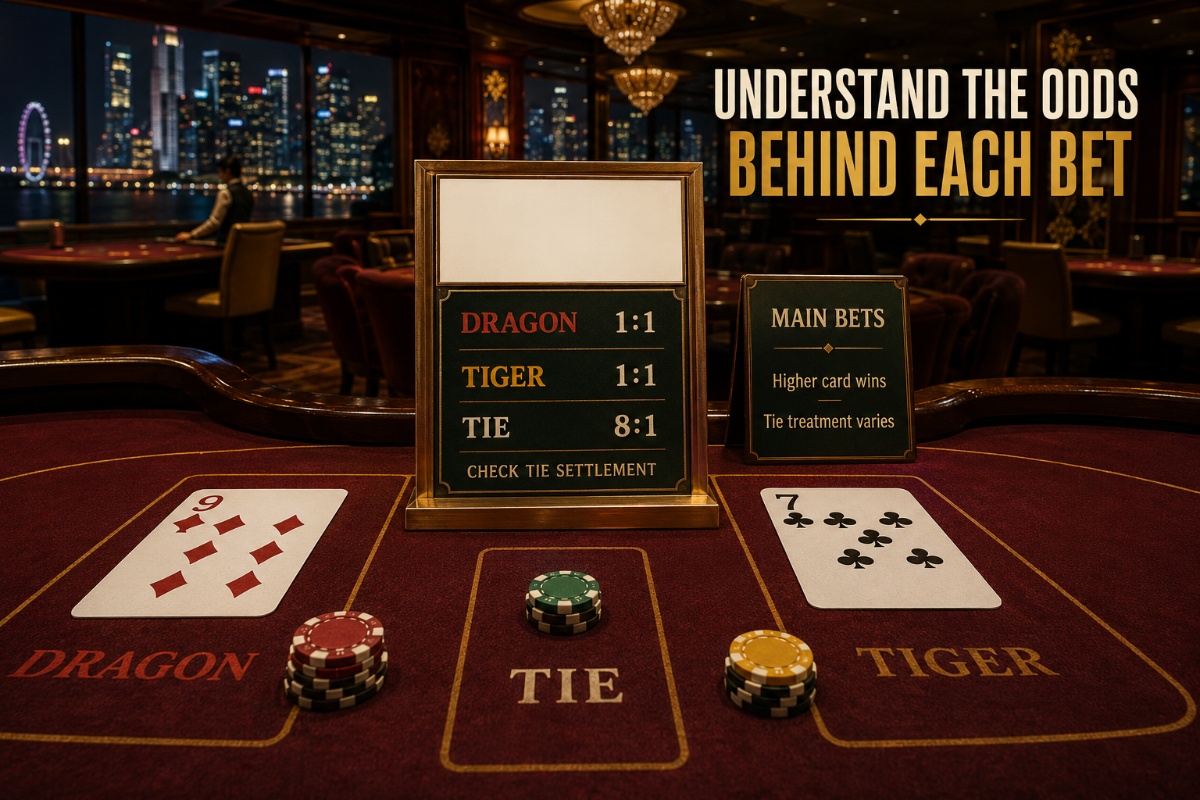
Dragon Tiger odds are simple to read on the surface, but the payout alone does not show the full risk of each selection. Dragon and Tiger usually pay even money, while Tie and other side bets display much larger returns because they occur less often and normally carry a higher house edge. The exact table rules must always be checked before a wager is confirmed.
How one round of Dragon Tiger works
Dragon Tiger odds begin with a very short card comparison. One card is dealt to the Dragon position and one to the Tiger position. The higher rank wins. Aces are normally low, kings are high, and suits do not break an ordinary tie unless the table offers a separate suited-tie wager.
There is no drawing decision and no hand-building stage. The outcome is based on the two exposed cards. That simplicity makes the game quick, but it does not make every market equally priced or equally favourable.
Read payout odds and probability separately
Dragon Tiger odds shown as 1:1 mean that a winning S$10 selection returns S$10 in profit plus the original S$10 stake. A Tie shown as 8:1 would return S$80 in profit plus the stake when it wins. The larger number does not mean the wager offers better underlying value.
Use two separate questions:
- How much does the market pay when it wins?
- How frequently can that result occur under the table rules?
The payout is visible on the layout; the probability depends on the cards, deck configuration, tie treatment, and rules.
Why Dragon and Tiger are usually close to equal
Dragon Tiger odds for the two main sides are usually identical because neither position receives a strategic advantage from the card order. In a standard multi-deck game, Dragon and Tiger each win slightly less than half of all rounds because a portion of outcomes finish as ties.
With eight standard decks and ranks treated equally, the probability of an ordinary tie is approximately 7.47%. The remaining outcomes divide evenly, leaving Dragon and Tiger at roughly 46.27% each. These calculations assume the usual eight-deck structure and no unusual rule variation.
This first Dragon Tiger payout guide principle is that a 1:1 payout should not be confused with a 50% chance of winning. Ties occupy part of the outcome space and affect the return on the main bets.
Check what happens to main bets on a tie
The most important Dragon Tiger odds rule is how the table treats Dragon and Tiger wagers when equal ranks appear. A common rule is that half of the main-bet stake is lost on a tie. Some variants may push, return, or settle the stake differently.
Suppose S$20 is placed on Dragon and both cards show a nine. Under a half-loss rule, S$10 would be lost and S$10 returned. Under a push rule, the full S$20 would be returned. That single difference changes the mathematical cost of the main market.
At an even-money payout with a half-loss on ties, the approximate house edge in a standard eight-deck model is 3.73%. Dragon Tiger odds change in value when the deck count or tie rule changes, so use the active game panel.
Why the Tie payout looks much larger
Dragon Tiger odds for Tie are commonly displayed at a much higher return because equal ranks occur far less often than either main-side win. If a standard Tie pays 8:1 and the theoretical tie probability is about 7.47%, the payout remains below the fair mathematical price.
A fair payout at that probability would be approximately 12.39:1 before any house margin. An 8:1 offer therefore creates a much larger house edge than the two main sides. Under the standard assumptions above, the approximate house edge is 32.77%.
The large potential return can dominate the layout visually, but it comes with a much lower hit rate. Dragon Tiger odds should therefore be compared through probability and settlement, not by payout size alone.
Understand suited ties and other side bets
Some tables add suited ties, colour bets, odd or even ranks, big or small cards, or suit-specific selections. Dragon Tiger odds for these options can vary significantly by provider and table version. The names may hide exclusions or restricted rank ranges.
A suited tie generally requires both cards to have the same rank and suit, making it rarer than an ordinary tie. The payout may be much larger, but the exact probability and house edge depend on the number of decks and the posted return.
The second Dragon Tiger payout guide rule is never to transfer a payout table from one version to another. Open the current information panel and match every side bet to its exact winning condition.
Use implied probability to interpret a payout
Dragon Tiger odds can be converted into break-even probability. For a simple x-to-one payout, use:
Break-even probability = 1 ÷ (payout + 1) × 100
An 8:1 Tie payout requires a break-even probability of 11.11%. If the estimated event probability is only 7.47%, the difference represents a substantial disadvantage before considering any other rule.
| Example market | Example payout | Break-even probability | Rule to verify |
|---|---|---|---|
| Dragon | 1:1 | 50.00% | Tie loss, half-loss, or push |
| Tiger | 1:1 | 50.00% | Tie loss, half-loss, or push |
| Tie | 8:1 | 11.11% | Ordinary tie definition |
| Side bet | Varies | Calculate from display | Decks, exclusions, and exact condition |
This shows the success rate needed for the payout to break even over many identical wagers; it does not predict a round.
Do previous cards change the next outcome?
Dragon Tiger odds do not become more favourable merely because Dragon, Tiger, or Tie has appeared several times in a row. A result history can describe earlier rounds, but it does not prove that the opposite side is due.
Cards are dealt without replacement until a shuffle, so composition changes slightly. Accurate calculation still requires the deck count, exposed cards, cut-card position, and procedure. A streak display cannot predict the next result.
Avoid increasing stakes because one side has lost repeatedly. A progression changes the amount risked, not the underlying payout rule.
Compare the table limit with the session budget
Dragon Tiger odds may be identical across several tables while the minimum and maximum stakes differ. A table with a S$20 minimum is not suitable for a S$50 session budget because a few rounds can consume the entire amount quickly.
Choose a stake that supports the planned rounds without an increase after a loss. Switching tables or games does not reset the budget. The displayed maximum is not a recommended stake.
Check speed and automatic rebet features
Dragon Tiger odds are often presented in a fast live-game format. Short betting windows and one-click rebet controls can compress several decisions into a few minutes. Dragon Tiger odds do not improve with speed, which can consume the session budget faster.
Turn off automatic rebet where possible and pause after each completed round. Confirm the market and stake again rather than assuming the previous selection is still appropriate.
Verify the exact Gembet table rules
Before using Gembet, open the current Dragon Tiger game-information panel and check the provider, deck count, main-bet payout, tie treatment, side-bet definitions, table limits, and maximum total payout. Dragon Tiger odds and rules may differ between tables.
Dragon Tiger is often included when readers compare the best table games, but its simple two-card format should not be mistaken for identical pricing across every version. The information displayed inside the active table is more reliable than a remembered payout from another provider.
Use a five-point check before each selection
Dragon Tiger odds can be reviewed quickly without relying on a betting system:
- Market: Confirm Dragon, Tiger, Tie, or the exact side bet.
- Payout: Read the displayed return rather than assuming a standard number.
- Tie rule: Check whether main bets lose fully, lose half, or push.
- Stake: Keep the amount inside the fixed session budget.
- Speed: Set a round or time limit before the session starts.
The final Dragon Tiger payout guide check is whether the wager still makes sense after the large payout figures and recent-results board are ignored.
Dragon Tiger odds worth understanding
Dragon Tiger odds are easiest to evaluate when the main sides, Tie, and optional side bets are treated as separate markets. Dragon and Tiger commonly pay 1:1 but may lose half the stake on a tie. Tie pays more because it occurs less often and typically carries a much higher house edge.
Read the live rules, calculate break-even probability, and confirm the table limit before playing. No card sequence guarantees the next winner, and changing stakes cannot remove the house margin. A fixed entertainment budget and a clear stopping point remain more useful than attempting to recover losses through faster or larger wagers.
Experience the real deal with SG's top Live Dealers. Play Baccarat, Roulette & more.

